Week 8 Single Artwork Blogpost
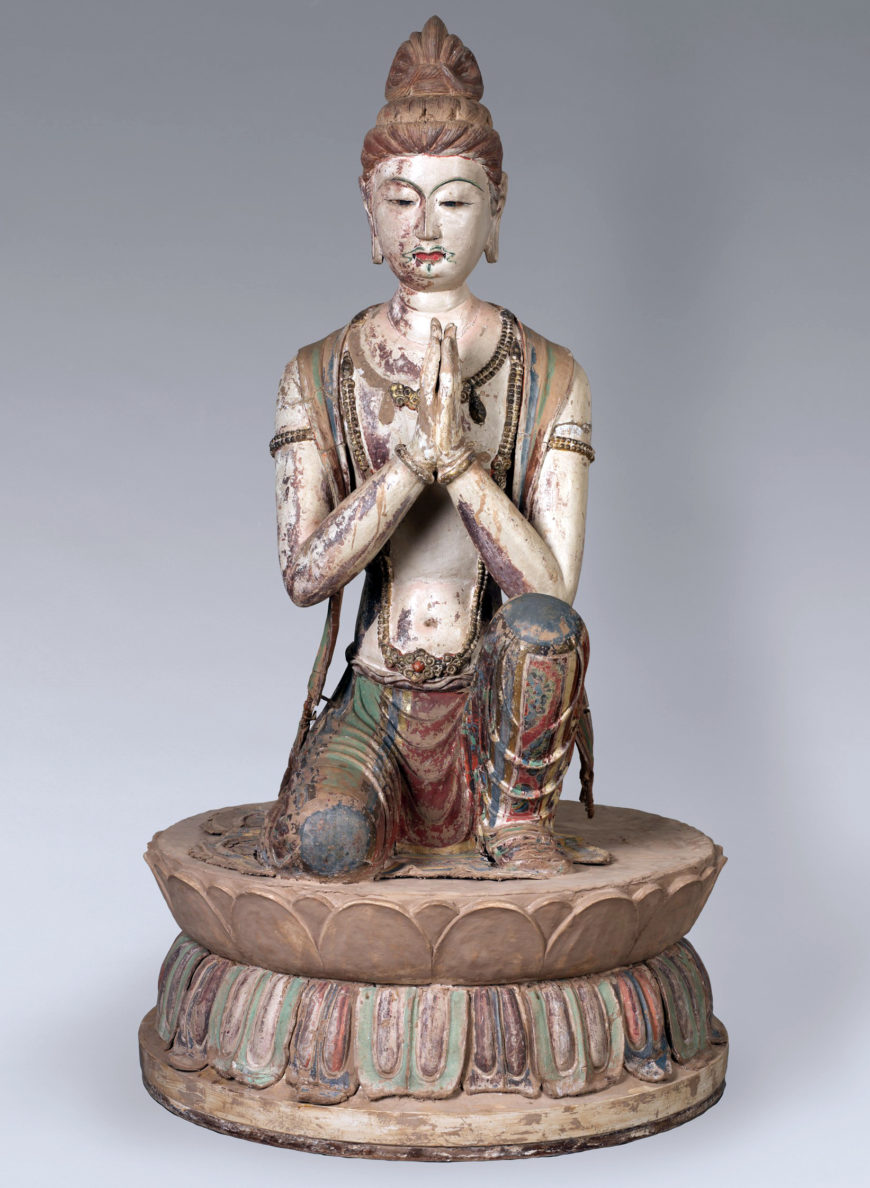 |
| Kneeling Attendant Bodhisattva, Late 7th Century. Dunhuang, China. Unfired Clay and Straw over Wooden Armature. Photo from Harvard Art Museums. |
This was one of eight figures surrounding a figure of a preaching Shakyamuni Buddha. It was found in the Mogao Complex in Dunhuang, China. It was found during the First Fogg Expedition to China in 1923-1924. It is currently in the collection of the Harvard Art Museums.
The figurine is a little over 48" tall and the base it sits on is roughly 28" across. It is made from a mix of clay mixed with fibers and straw, over a wooden armature, to give it some structure. Some white was added to the surface of the statue, along with polychromy and gilding. The figurine also wears jewelry and flowing clothing. The white is used on the skin, while the polychromy and gilding is used on the jewelry and clothing. It is kneeling on a lotus flower, hands clasped flat against each other. Like most sacred figures in Buddhist art, the figure has long earlobes.
The technique that was used to create the statue, while stronger than just dry clay without any reinforcement, is still fragile and susceptible to moisture damage and shock. I'm honestly surprised that it survived shipment to the US with only one damaged part. Unsealed, unfired clay rapidly picks up moisture, which would have caused the coloration to fissure and flake off.
This is a piece that I think should have stayed near its place of discovery. The fact that it was a part of a larger collection of Buddhist artifacts found at the Mogao Complex, a Buddhist site that was probably trashed by the expedition, means that it was taken out of its original context. It's would similar to removing a statue of a saint off a cathedral.
 |
| Yoshida Family Obutsudan |


Comments
Post a Comment